Appenzeller® Cheese Pass
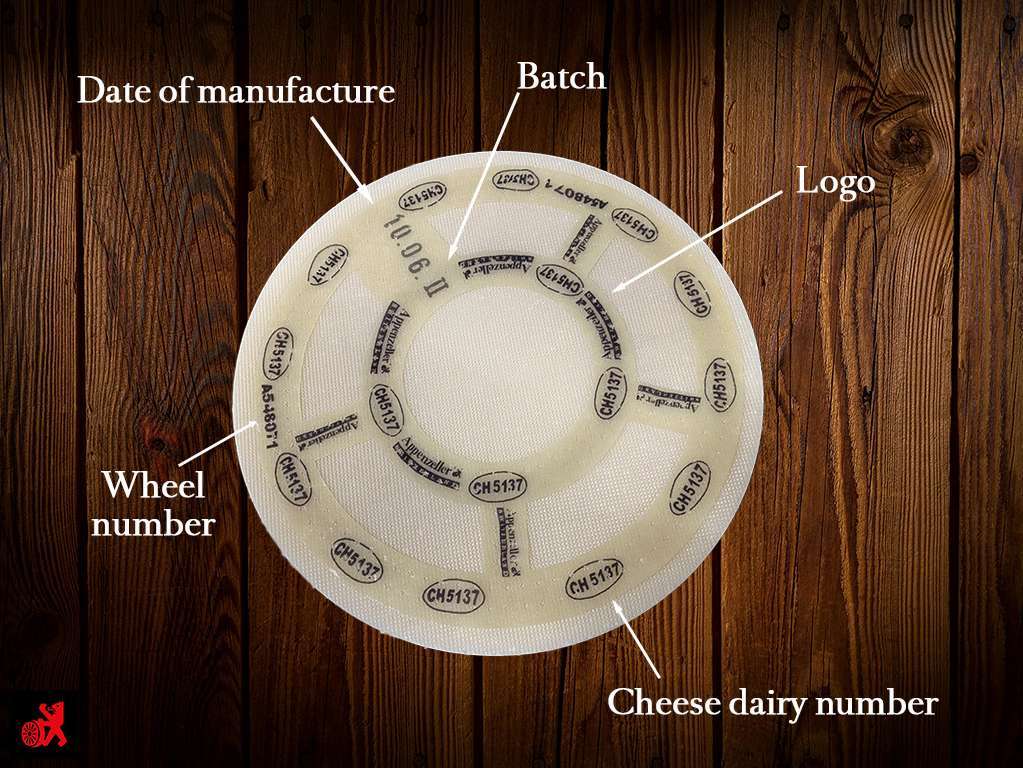
The cheese pass guarantees the first-class quality of each individual wheel. It is provided with the cheese dairy number, guarantee of origin, date of manufacture and wheel numbering and allows every piece of Appenzeller® cheese with rind to be checked for authenticity.
Quality seal
Appenzeller® cheese pass clearly stands out from conventional quality seals. The Appenzeller® cheese pass is designed to cover the entire cheese wheel and thus guarantees the authenticity of the product on each piece of Appenzeller®. In addition, the cheese pass is provided with the Appenzeller® logo. The following information can be read from such a cheese pass:
Batches
A batch comprises the number of cheese wheels that can be produced in the same production run.
An average Appenzeller® cheese dairy produces 80 wheels per batch, which requires around 6000 litres of fresh milk, which was produced without silage feeding. Farms that produce more than 1 batch per day mark this with a Roman numeral on the cheese pass.
Wheel number
In addition to the batch number, each cheese is given an individual number. If 80 cheeses are produced in a batch and the first cheese has the number 800000, the cheeses are numbered consecutively. This means that the last cheese in the batch, i.e. the 80th cheese, has the number 800079. Each Appenzeller® cheese dairy has its own number range.
Cheese factory number
Every cheese dairy has a licence to produce food of animal origin and receives an operating licence number or CH-number. In the case of Appenzeller® cheese these numbers are always four digits long. One example is the Appenzeller® show dairy, which bears the number CH-5137.
The techniques for applying the cheese pass differ from cheese dairy to cheese dairy. The cheese pass is placed on the cheeses immediately after curd filling or during the pressing process. The subsequent pressing ensures that the cheese pass adheres firmly to the cheese surface.
During maturation, the cheese pass is increasingly covered by cheese smear, making it an integral part of the cheese rind. For this reason, the quality seal is not immediately visible to consumers. However, the smear can be easily scraped off with a knife, which makes it easy to prove the authenticity of the cheese. The cheese pass also known as casein mark is made of casein – a protein component of milk – so that the cheese pass has no influence on the quality of the cheese.